Registration for our January 16th lecture, The Secret Life of Harbor Porpoises with Dr. Cindy Elliser, opens on Friday, January 2nd at 9:00am. Please click the button below to reserve your seats!
January 16th Lecture: The Secret Lives of Harbor Porpoises With Pacific Mammal Research Co-Founder Dr. Cindy Elliser
Harbor Porpoises are one of the most abundant marine mammal species in the Salish Sea, however there is much we don’t know about this often elusive species. Pacific Mammal Research (PacMam) has spent over 10 years conducting behavioral and photo-identification research on Harbor Porpoises to learn about their behavior, ecology, movement patterns, etc.
February 20th Lecture: The March Point Heronry - A Bird's Eye View With Skagit Land Trust's Stacy Dahl & Anne Winkes
Stacy and Anne will take us into the March Point heronry, giving us a behind the scenes look at life for a Blue Heron throughout the 2025 breeding and nesting season, sharing expected and unexpected behaviors, with an intimate focus on three of the nests experiencing success and failure, as the adults work to rear young to fledging.
March 13th Lecture: A Healthy Salish Sea Starts With Kelp With Seattle Aquarium ROV Researcher Dr. Zachary Randell
Dr. Zachary Randell leads the Coastal Climate Resilience (CCR) research program at the Seattle Aquarium, leveraging small, remotely operated vehicles (ROVs), equipped with cameras, sensors, and open-source AI tools, to conduct high‑resolution video and photo surveys of kelp forests and other benthic habitats in shallow coastal waters (5–40 m depth).
Dive Into the World of the Giant Pacific Octopus with Tim Carpenter Thursday, May 21, 2026 Edmonds College – Black Box Theater
Join us for an engaging lecture with Tim Carpenter from the Seattle Aquarium as he unravels the mysteries of one of the ocean’s most remarkable creatures — the Giant Pacific Octopus!
The giant Pacific octopus is an iconic resident of the Salish Sea and the North Pacific Ocean. As the largest octopus species on Earth, it plays a critical role in coastal ecosystems – both as a top predator and as an important prey species for animals such as sea otters and orcas. In this talk, Tim will explore the biology and ecology of the Giant Pacific Octopus in the Salish Sea, weaving together scientific insight with firsthand stories from his work as a veteran animal care professional and conservation biologist to bring these remarkable animals and their ecological role vividly to life.
Check back for more lectures in Edmonds next year!
Please use the link below to register for tickets at Eventbrite.
The Return of the Sunflower Sea Star: Reviving a Critical Species of the Kelp Forest with Dr. Jason Hodin Thursday, March 19, 2026 Edmonds College – Black Box Theater
Once a common sight along the Pacific Coast, sunflower sea stars have been pushed to the brink by sea star wasting disease – triggering cascading impacts on kelp forests as unchecked purple urchins move in. Dr. Jason Hodin of Friday Harbor Laboratories is leading groundbreaking research to understand what went wrong and how recovery might be possible. In this talk, he’ll share the detective work behind identifying the disease, the challenges and successes of raising sunflower sea stars in captivity, and how restoring this important predator could help heal entire coastal ecosystems.
Washington Natural Areas Program: Conserving Washington’s Native Species and Ecosystems for Future Generations
David Wilderman, Lead Scientist for WA Department of Natural Resources, Natural Areas Program
May 14, 2026 at 7:00 pm., Lacey Community Center
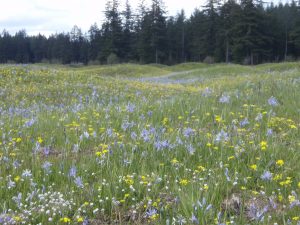
Take a tour of beautiful Natural Areas that showcase the extraordinary features these sites protect, then delve into some of the work being done to manage and restore these very special protected areas. David Wilderman will also share how natural areas have been designed to capture Washington’s plant diversity and ecosystems that also support a wide range of sensitive animals and birds as well.
Guiding Biodiversity Conservation in Washington State
Joe Rocchio, Program Manager of the Washington Department of Natural Resources, Natural Heritage Program
April 9, 2026 7:00 pm, Lacey Community Center
Washington’s beautiful landscapes support a tremendous diversity of ecosystems including marine eelgrass beds, tidepools, salt marshes, lowland rainforests, montane coniferous forests, subalpine and alpine meadows and parklands, shrub steppe, grasslands, prairies, sand dunes, riparian areas, forested swamps, vernal pools, marshes, fens and bogs. These ecosystems in turn support thousands of species, some of which are unique to Washington and not found anywhere else on earth. Much of this biodiversity is threatened by changes in land use, invasive species, climate change, and many other factors.
This presentation will introduce you to our state’s amazing array of biodiversity, discuss the stressors that threaten their long-term viability, and review how the activities of Washington Department of Natural Resources’, Natural Heritage Program play a critical role for informing and guiding biodiversity conservation in Washington State.
Water We Up To? The New Science of Washington’s Aquatic Reserves
Austin Greene, Ph.D., Lead scientist for Washington Department of Natural Resources, Aquatic Reserves Program
April 30, 2026 7:00 pm, Lacey Community Center
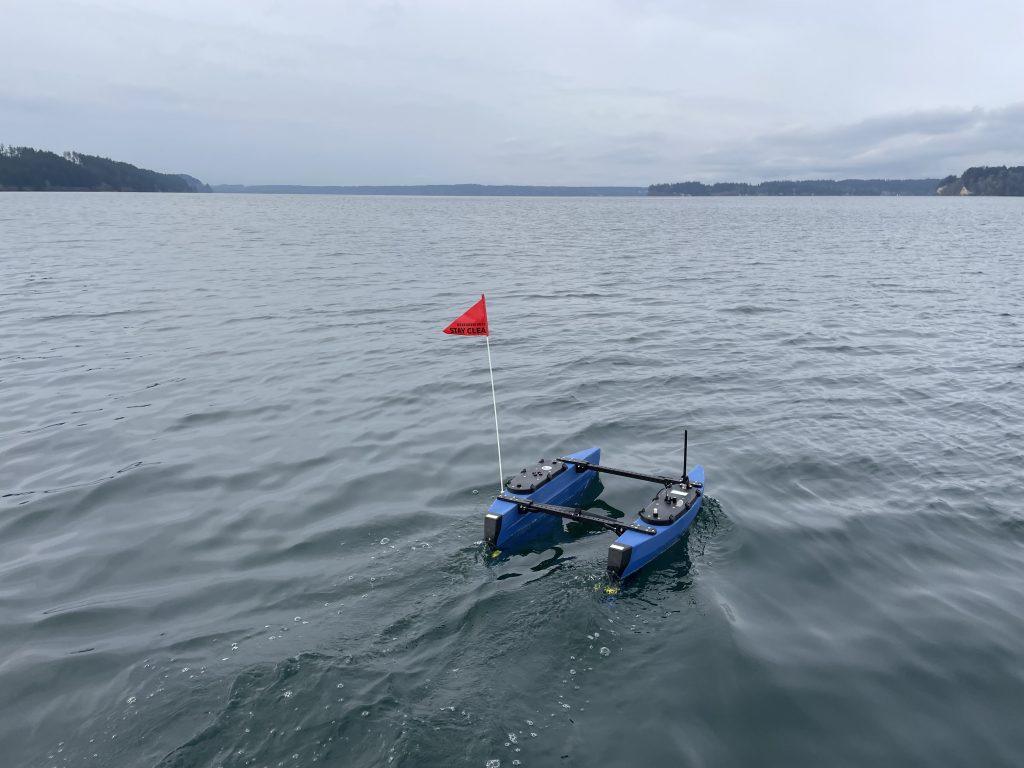
Austin Greene leads a team of scientists and technicians working to better understand the unique habitats on eight Aquatic Reserves in Washington and the impacts challenging the future of these ecosystems. In this presentation Austin will highlight some of the new methods being used to study aquatic lands on Reserves including a robotic surface vessel for mapping marine plants, underwater camera systems, autonomous reef monitoring structures (ARMS) and more. Preliminary results from select projects will be presented alongside an overview of upcoming research on Aquatic Reserves and the program’s value as a professional development experience for young scientists.
The BlueBoat, a robotic boat used by the Aquatic Reserves program to map marine vegetation
Thank you for helping us make last year’s Lecture Series a success! Click below to take a look at our last year’s amazing guest speakers. From learning about Giant Pacific Octopuses to the volcanoes of Washington State, we learned so much for our phenomenal expert lecturers.
The original lecture series was started in 2005 as a class project by a small group of Washington State University (WSU) Beach Watcher students. Recognizing that the public had a keen interest in the local marine environment and the natural world, the Beach Watcher students were determined to connect this knowledge-hungry public with regional experts on a variety of environmentally oriented topics. And the rest is history!
Looking for a way to get involved and give back to the community? Become a Friends of the Salish Sea volunteer as hospitality guide for the lecture series! Help make the lecture series a success by assisting with set up, welcoming in guests, and cleaning up after the event. Please email us at analectures@friendsofsalishsea.org.